
CoderSathi
  • Tutorial
    • Java Tutorial
    • Swing Tutorial
    • JDBC Tutorial
    • Java String Tutorial
    • Servlet and JSP Tutorial
  • Mongo DB
  • AWS
  • DevOps
  • Linux
  • Git
Home > Swing > BoxLayout in Java Swing

Swing Tutorial

  • What Is Java Swing
  • First Program
  • What is AWT
  • Advantages of Swing Over AWT
  • JFrame
  • Swing Components
  • JLabel
  • JTextField
  • JPasswordField
  • JButton
  • Event Handling
  • FlowLayout
  • BorderLayout
  • GridLayout
  • GridBagLayout
  • BoxLayout
  • JPanel
  • JCheckBox
  • JRadioButton
  • Border Component
  • JComboBox
  • JList
  • JList with MVC
  • Mouse Event
  • Key Event
  • JMenuBar
  • JTextArea
  • Using Color
  • Use Font
  • Display Image/Icon
  • Dialog Box
  • JTable
  • JDesktopPane and JInternalFrame
  • JDesktopPane
  • JInternalFrame
  • Adapter Classes
  • Swing Timer
  • JScrollPane
  • JSlider
  • JProgressBar
  • JSeparator
  • JToolBar
  • ActionListener
  • ItemListener
  • Worker Thread
  • Nimbus Look and Feel

BoxLayout in Java Swing

Learn the concepts, implementation details, and practical steps with a clean developer-focused walkthrough.

Yuba Raj Kalathoki
By Yuba Raj Kalathoki
Published: March 11, 2021 ยท 1 min read ยท 0 Comments
Share: in X

BoxLayout is a layout manager in Java Swing that arranges components either vertically or horizontally in a single line. It provides two orientation modes: X_AXIS (horizontal) and Y_AXIS (vertical), which can be set using the BoxLayout constructor.

To use BoxLayout, we first need to create a container and set its layout to BoxLayout.

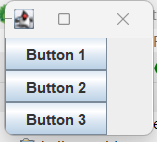
Following is an example of creating a JFrame and setting its layout to BoxLayout with vertical orientation:

import javax.swing.BoxLayout;
import javax.swing.JButton;
import javax.swing.JFrame;
import javax.swing.JPanel;

public class BoxLayoutDemo extends JFrame {
	public BoxLayoutDemo() {
		JPanel panel = new JPanel();
		panel.setLayout(new BoxLayout(panel, BoxLayout.Y_AXIS));
		panel.add(new JButton("Button 1"));
		panel.add(new JButton("Button 2"));
		panel.add(new JButton("Button 3"));
		getContentPane().add(panel);
		pack();
		setVisible(true);
	}

	public static void main(String[] args) {
		new BoxLayoutDemo();
	}

}

Output:
BoxLayout in Java Swing

Related Posts:

  • Constructor in Java
  • Vertical scaling and Horizontal scaling
  • Layout Management in Java Swing
  • Java Swing Tutorial
  • Command Line Arguments in Java
  • Extends Keyword in Java: A Deep Dive into Inheritance
Tags:javaswing
Was this article helpful?
โ† Previous ArticleThread in Java
Next Article โ†’Uses of JDBC in Java

Leave a Comment Cancel reply

You must be logged in to post a comment.

Recent Posts

  • How to Use AWS CloudFront Signed URLs in Spring Boot?
  • How to Fix SSH Agent Forwarding on macOS: The Ultimate Guide for Developers
  • How to Read AWS Secrets Manager in Spring Boot (Step-by-Step)
  • How to Fix “Public Key Retrieval is not allowed” MySQL JDBC Error
  • Complete Guide to JaCoCo: How to Measure Java Code Coverage Accurately
CoderSathi

Your go-to resource for Java, Spring Boot, Microservices, AWS, and modern development tutorials.

Linkedin

Quick Links

  • About
  • Contact

Popular Topics

  • Java
  • Spring Boot
  • AWS
  • DevOps
  • MongoDB
  • Linux
  • Git
  • How to
ยฉ 2026 CoderSathi. All rights reserved. Privacy Policy ยท Sitemap