CoderSathi
  • Tutorial
    • Java Tutorial
    • Swing Tutorial
    • JDBC Tutorial
    • Java String Tutorial
    • Servlet and JSP Tutorial
  • Mongo DB
  • AWS
  • DevOps
  • Linux
  • Git
Home > Java > How Java Is Platform Independent?

Java Tutorial

  • Introduction
    • What is Java
    • History Of Java
    • Install Java
    • What is JVM
    • JDK vs JRE vs JVM
    • Java Bytecode
    • OOP vs POP
    • Compile and Run Java
  • Tokens, Expressions and Control Structures
    • Primitive data types
    • Integers
    • Floating Points
    • Characters
    • Booleans
    • User Defined Data Type
    • Declarations
    • Constants
    • Identifiers
    • Literals
    • Type Conversion and Casting
    • Variables
    • Default Variable Initialization
    • Command Line Arguments
    • Arrays of Primitive Types
    • Comment Syntax
    • Garbage Collection
    • Expressions
    • Operators
    • Arithmetic Operator
    • Bitwise and Shift Operator
    • Comparison or Relational Operators
    • Logical Operators
    • Assignment Operators
    • Ternary Operator
    • Increment and Decrement Operator
    • Control Statements
  • OOP Concepts
    • Class and Object
    • Create Class Instance
    • Method
    • Abstraction
    • Encapsulation
    • this keyword
    • Constructor
    • Pass by Value
    • Access Modifier/Control
    • Polymorphism
    • Method Overloading vs Method Overriding
    • Recursion
    • Nested and Inner Class
  • Inheritance and Packaging
    • Inheritance
    • extends Keyword
    • super Keyword
    • Object Class
    • Abstract class
    • Final Class
    • Java Package
    • Interface
  • Handling Error/ Exceptions
    • What is Exception
    • Exception Handling Keywords
    • Common Java Errors
    • User Defined Exception
    • Throwing and re-throwing Exception
    • finally Block
  • Strings
    • Java String Tutorial
  • Threads
    • Introduction
    • Create Thread
    • Thread Lifecycle
    • Thread Priority
    • Thread Synchronization
    • Inner Thread Communication
    • Thread Deadlock
  • IO and Streams
    • java.io Package
    • Files and Directories
    • Byte Stream
    • Character Stream
    • Console Input and Output
    • Serializable and Deserializable
  • Core Packages
    • java.lang Package
    • Math
    • Wrapper Classes
    • java.lang.Number
    • Double
    • Float
    • Integers
    • java.lang.Byte
    • java.lang.Short
    • java.lang.Long
    • java.lang.Character
    • java.lang.Boolean
    • java.util package
    • Vector Class
    • Stack Class
    • Dictionary Class
    • Hashtable
    • Enumeration or Enum
    • Generate Random Number
  • Holding Collection of Data
    • Arrays
    • Map
    • List
    • Set
    • Collection Interface
    • Collections Class
    • ArrayList
    • HashSet
    • TreeSet
    • Comparator
  • Java Bean
    • What is Java Bean
    • Advantages and Disadvantages of Java Bean
    • Java Beans API
    • Introspection
    • Java Bean Properties
    • Bound and Constrained Properties
    • BeanInfo Interface
    • Customizers
    • Java Beans Persistence
    • BeanDescriptor
  • Home

How Java Is Platform Independent?

Learn the concepts, implementation details, and practical steps with a clean developer-focused walkthrough.

Yuba Raj Kalathoki
By Yuba Raj Kalathoki
Last updated: July 1, 2026 ยท 2 min read ยท 0 Comments
Share: in X
Why Java is Platform Independent

Before directly jumping to the reason first, we must understand how Java actually works and what are the components available in Java. So that we can easily understand how Java is a platform independent language, which is essential to its functionality.

We all know that Java is a widely used programming language and probably, it is the first choice of large enterprise companies for the last 2 decades and so on. The main reason Java is so popular even today is that Java is platform independent and available everywhere. Whether it is in web applications or smartphones or in smartwatches or IoT devices, Java is present everywhere.

How Java execution work?
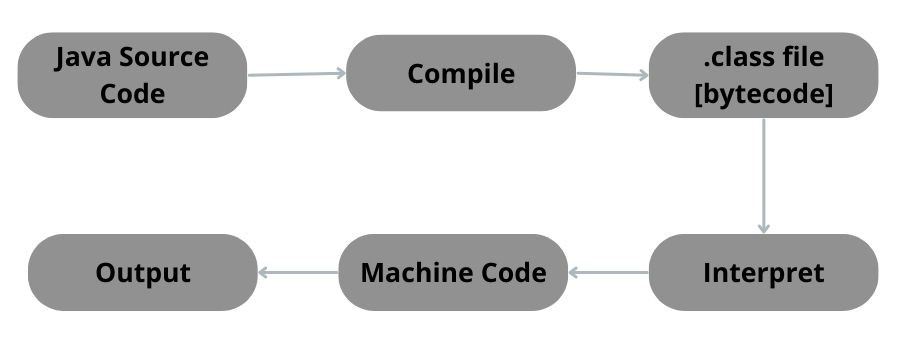
Java Compilation Process
Java Execution flow

When we compile a Java source code using the javac command the compiler generates a .class file.

JVM interprets the class file into machine code and the magic happens as an output.

Now, the question may come What is JVM?

The JVM is the main pillar of Java that makes it so popular and platform independent. JVM is platform dependent but it is available in all the machines where JRE is installed.

Java has three important components:

JDKJDK provides all the tools that are needed to develop Java applications.
JREJRE creates a runtime environment so that JVM does its work based on the specification defined.
JVMJVM is an abstract machine so it does nothing without JRE. It comes along with JRE installation.

The post difference between JDK, JRE and JVM explains in detail if you want to learn in depth.

JDK, JRE, and JVM are platform dependent this is because the execution of each operating system is different.

But,

Java is platform independent.

Because, the actual answer you are looking for is ๐Ÿ‘‡:

Java is platform independent because:

  1. Java compiler javac compiles the Java code and generates .class file.
  2. The .class file is a bytecode that does not understand by the Operating System.
  3. JVM converts bytecode to machine code (binary) so that computer can understand it.
  4. JVM is available in every machine where JRE is installed. Any valid bytecode is interpreted by JVM irrespective of the operating system.

This is the reason that we say Java is platform independent.

Conclusion

Java is not platform independent itself. The bytecode makes Java a platform independent language. An intermediate code bytecode is understood by JVM only. The JVM is available for all platforms. This is the reason that we say Java is a platform independent programming language.

Related Posts:

  • Control Statements in Java
  • What Is Java Swing? A Complete Guide to Javaโ€™s GUI Toolkit
  • What is Java? Exploring Its Key Features, Benefits,…
  • A Brief History Of Java
  • Identifiers in Java
  • MySQL Commands for Developers
Tags:java
Was this article helpful?
โ† Previous ArticleLogical Operator in MongoDB
Next Article โ†’Difference Between JDK JRE and JVM

Leave a Comment Cancel reply

You must be logged in to post a comment.

Recent Posts

  • How to implement Passwordless Authentication in Spring Boot: A Step-by-Step Guide
  • How to Use AWS CloudFront Signed URLs in Spring Boot?
  • How to Fix SSH Agent Forwarding on macOS: The Ultimate Guide for Developers
  • How to Read AWS Secrets Manager in Spring Boot (Step-by-Step)
  • How to Fix “Public Key Retrieval is not allowed” MySQL JDBC Error
CoderSathi

Your go-to resource for Java, Spring Boot, Microservices, AWS, and modern development tutorials.

Linkedin

Quick Links

  • About
  • Contact

Popular Topics

  • Java
  • Spring Boot
  • AWS
  • DevOps
  • MongoDB
  • Linux
  • Git
  • How to
ยฉ 2026 CoderSathi. All rights reserved. Privacy Policy ยท Sitemap