
CoderSathi
  • Tutorial
    • Java Tutorial
    • Swing Tutorial
    • JDBC Tutorial
    • Java String Tutorial
    • Servlet and JSP Tutorial
  • Mongo DB
  • AWS
  • DevOps
  • Linux
  • Git
Home > Java > What is JSP in Java?

Java Tutorial

  • Introduction
    • What is Java
    • History Of Java
    • Install Java
    • What is JVM
    • JDK vs JRE vs JVM
    • Java Bytecode
    • OOP vs POP
    • Compile and Run Java
  • Tokens, Expressions and Control Structures
    • Primitive data types
    • Integers
    • Floating Points
    • Characters
    • Booleans
    • User Defined Data Type
    • Declarations
    • Constants
    • Identifiers
    • Literals
    • Type Conversion and Casting
    • Variables
    • Default Variable Initialization
    • Command Line Arguments
    • Arrays of Primitive Types
    • Comment Syntax
    • Garbage Collection
    • Expressions
    • Operators
    • Arithmetic Operator
    • Bitwise and Shift Operator
    • Comparison or Relational Operators
    • Logical Operators
    • Assignment Operators
    • Ternary Operator
    • Increment and Decrement Operator
    • Control Statements
  • OOP Concepts
    • Class and Object
    • Create Class Instance
    • Method
    • Abstraction
    • Encapsulation
    • this keyword
    • Constructor
    • Pass by Value
    • Access Modifier/Control
    • Polymorphism
    • Method Overloading vs Method Overriding
    • Recursion
    • Nested and Inner Class
  • Inheritance and Packaging
    • Inheritance
    • extends Keyword
    • super Keyword
    • Object Class
    • Abstract class
    • Final Class
    • Java Package
    • Interface
  • Handling Error/ Exceptions
    • What is Exception
    • Exception Handling Keywords
    • Common Java Errors
    • User Defined Exception
    • Throwing and re-throwing Exception
    • finally Block
  • Strings
    • Java String Tutorial
  • Threads
    • Introduction
    • Create Thread
    • Thread Lifecycle
    • Thread Priority
    • Thread Synchronization
    • Inner Thread Communication
    • Thread Deadlock
  • IO and Streams
    • java.io Package
    • Files and Directories
    • Byte Stream
    • Character Stream
    • Console Input and Output
    • Serializable and Deserializable
  • Core Packages
    • java.lang Package
    • Math
    • Wrapper Classes
    • java.lang.Number
    • Double
    • Float
    • Integers
    • java.lang.Byte
    • java.lang.Short
    • java.lang.Long
    • java.lang.Character
    • java.lang.Boolean
    • java.util package
    • Vector Class
    • Stack Class
    • Dictionary Class
    • Hashtable
    • Enumeration or Enum
    • Generate Random Number
  • Holding Collection of Data
    • Arrays
    • Map
    • List
    • Set
    • Collection Interface
    • Collections Class
    • ArrayList
    • HashSet
    • TreeSet
    • Comparator
  • Java Bean
    • What is Java Bean
    • Advantages and Disadvantages of Java Bean
    • Java Beans API
    • Introspection
    • Java Bean Properties
    • Bound and Constrained Properties
    • BeanInfo Interface
    • Customizers
    • Java Beans Persistence
    • BeanDescriptor

What is JSP in Java?

Learn the concepts, implementation details, and practical steps with a clean developer-focused walkthrough.

Yuba Raj Kalathoki
By Yuba Raj Kalathoki
Last updated: July 1, 2026 · 2 min read · 0 Comments
Share: in X

JavaServer Pages (JSP) is a technology used to create dynamic web content in Java. It’s a part of the Java EE (Enterprise Edition) platform and simplifies the process of developing web applications.

Key Points about JSP

  1. Combines HTML and Java: JSP allows developers to write HTML pages that include Java code. This makes it easy to create interactive and dynamic web pages.
  2. Server-Side Scripting: Unlike client-side scripts (like JavaScript), JSP runs on the server. When a user requests a JSP page, the server processes the Java code and sends back an HTML page to the user’s browser.
  3. Easy to Learn: If you know HTML and Java, learning JSP is straightforward. You can embed Java code directly within HTML using special tags.
  4. Reusable Components: JSP supports reusable components like JavaBeans, custom tags, and tag libraries, which promote clean and modular code.
  5. MVC Architecture: JSP often works with servlets to implement the Model-View-Controller (MVC) design pattern. JSPs handle the View (presentation), while servlets handle the Controller (logic) and interact with the Model (data).

Basic Structure of a JSP File

A typical JSP file has a .jsp extension and contains a mix of HTML and Java code.

Following is a simple example:

<%@ page language="java" contentType="text/html; charset=UTF-8" %>
<!DOCTYPE html>
<html>
<head>
    <title>Welcome</title>
</head>
<body>
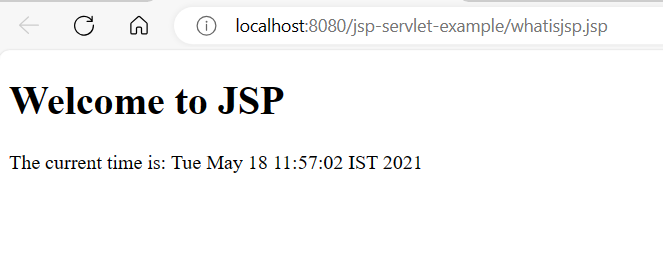
    <h1>Welcome to JSP</h1>
    <p>The current time is: <%= new java.util.Date() %></p>
</body>
</html>
  • Directives (<%@ %>): Set page-level settings, like the language used (Java).
  • Scriptlets (<% %>): Contain Java code snippets. In the example, <%= new java.util.Date() %> inserts the current date and time.
  • Expressions (<%= %>): Evaluate and output Java expressions directly to the HTML.

Output
jsp in java

Benefits of Using JSP

  • Separation of Concerns: Keeps the presentation layer (HTML) separate from the business logic (Java).
  • Scalability: Suitable for building large, scalable web applications.
  • Integration: Easily integrates with other Java technologies and frameworks, such as Spring and Hibernate.

Conclusion

JSP is a powerful tool for Java developers looking to build dynamic web applications. Its integration of HTML and Java makes it an ideal choice for creating interactive, server-side web pages. Understanding JSP is a valuable skill for any aspiring web developer in the Java ecosystem.

Related Posts:

  • Control Statements in Java
  • What is Java? Exploring Its Key Features, Benefits,…
  • MySQL Commands for Developers
  • What Is Java Swing? A Complete Guide to Java’s GUI Toolkit
  • Identifiers in Java
  • Packages in Java: A Guide to Modular, Maintainable Code
Tags:javajspserver-side-prograing
Was this article helpful?
← Previous ArticleAuto Generate Created and Modified Date Time in Spring Boot
Next Article →MySQL Commands for Developers

Leave a Comment Cancel reply

You must be logged in to post a comment.

Recent Posts

  • How to implement Passwordless Authentication in Spring Boot: A Step-by-Step Guide
  • How to Use AWS CloudFront Signed URLs in Spring Boot?
  • How to Fix SSH Agent Forwarding on macOS: The Ultimate Guide for Developers
  • How to Read AWS Secrets Manager in Spring Boot (Step-by-Step)
  • How to Fix “Public Key Retrieval is not allowed” MySQL JDBC Error
CoderSathi

Your go-to resource for Java, Spring Boot, Microservices, AWS, and modern development tutorials.

Linkedin

Quick Links

  • About
  • Contact

Popular Topics

  • Java
  • Spring Boot
  • AWS
  • DevOps
  • MongoDB
  • Linux
  • Git
  • How to
© 2026 CoderSathi. All rights reserved. Privacy Policy · Sitemap